

The Year Ahead 2027
The Year Ahead is the Santander Research’s Team flagship annual publication. This report takes a step back from the day-to-day news flow and look at the bigger picture. This year's title, “From Resilience to Growth”, captures the central theme of the publication: how the global economy has absorbed an extraordinary succession of shocks and has proved more resilient than many expected.

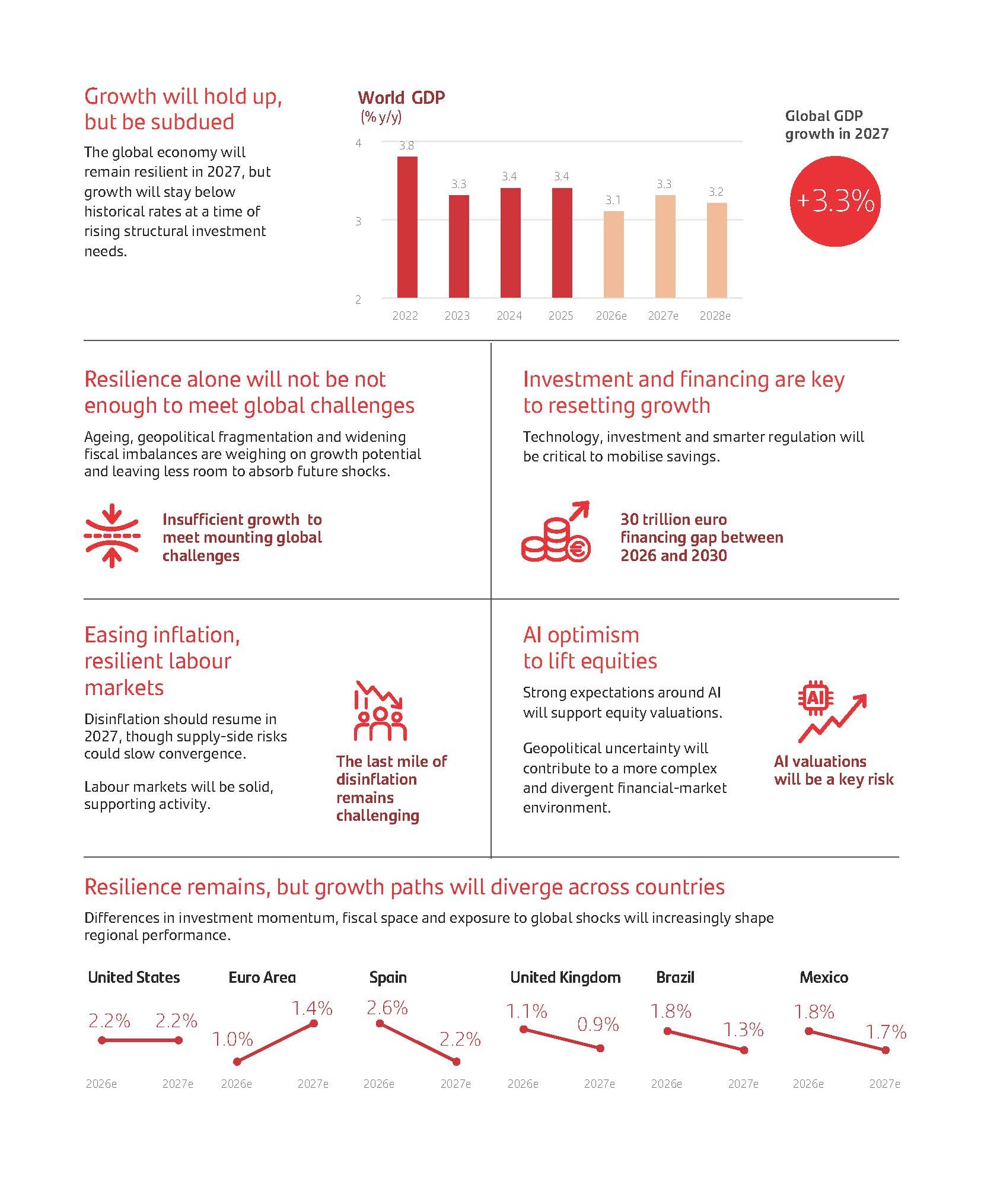
The Year Ahead at a glance
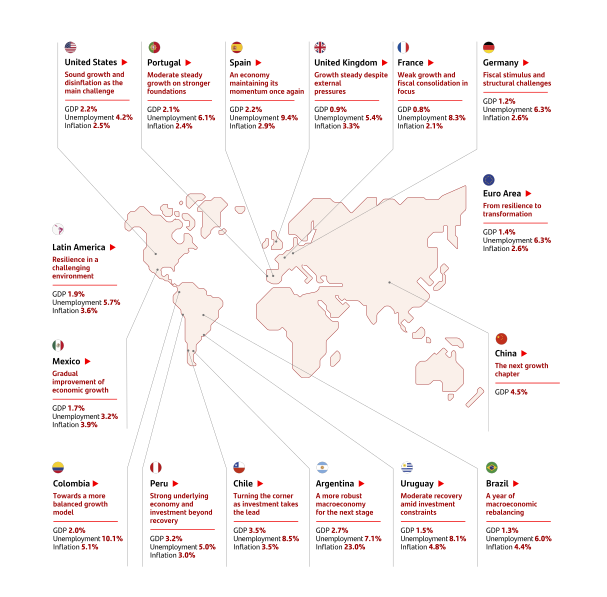
Regional and country focus in 2027
How much financing does the world need?
Artificial intelligence and new technologies (AI), population ageing, energy transition and national security: all these mega trends will require increasing financing over the next years. Our preliminary estimates for 2026-2030 suggest that the world needs to invest around 50 trillion euros over 2026–2030 and, given the financing sources currently available and their expected growth rate, the financing gap would be around 30 trillion euros.
Rethinking the macroeconomic framework in a supply-driven world
All the global shocks the world has experienced over the past six years have one common feature and it is the same denominator shared by the four megatrends that will shape the global economy in the future: they are all issues related to the aggregate supply side of the economy.
Macroeconomics of artificial intelligence
AI's trajectory to becoming the next General-Purpose Technology (GPT) remains steady and rapid, capturing all the attention. It has a dominant role not only in the narratives but also in the dynamics of financial markets, and is already making a visible economic impact on investment in the US. Its impact is not yet so evident on employment and aggregate productivity, and there are huge uncertainties about the magnitude and timing of its potential medium term macroeconomic impact and differences among countries.
European Banking Union: from firewall to engine of growth
The European banking sector is in a stronger position than it was a decade ago, yet it remains too fragmented to play its full role in financing Europe’s strategic agenda. Completing the Banking Union, alongside deeper capital markets is no longer merely a matter of financial stability: it is a key lever for mobilising savings, achieving scale, reducing financing costs and narrowing Europe’s investment gap. Ultimately, it is a driver of competitiveness and growth.

Defense spending in the EU: between opportunity and the fiscal dilemma
The recent increase in defence spending opens a new chapter for the European economy: it can boost activity in the short term and strengthen the industrial base if managed well, but its true effect will depend on how it is financed, organised and translated into productive capacity. This article examines that balance between opportunity and fiscal dilemma.
The European car industry: from regulatory compliance to industrial competitiveness
Europe is no longer alone on the great circuit of new mobility, but it remains one of the bestplaced contenders to lead the next race for the car of the future. The electric vehicle has shifted the industry’s centre of gravity: from engine to battery, from mechanics to software, from brand to scale, and from regulation to industrial policy. Europe’s opportunity lies in turning a demanding climate transition into a new platform for competitiveness. The task now is to manufacture the car of the future in Europe.
Latin America's role in the new geopolitical landscape
In a fragmented world, Latin America is gaining importance in the global economic conversation. The region combines critical minerals, clean energy, agri-food capacity, biodiversity and a geographical position. these strengths create opportunity for the region to play a larger role in global value chains and boost its growth prospects. Yet realising this potential depend on its ability to transform them into investment, productivity gains, skilled employment and greater value added.