Are you looking for your online banking?


At Santander, we work to protect the integrity of the financial system. This commitment includes preventing money laundering, terrorist financing, breaches of international sanctions, and other risks associated with illicit activities related to financial crime.
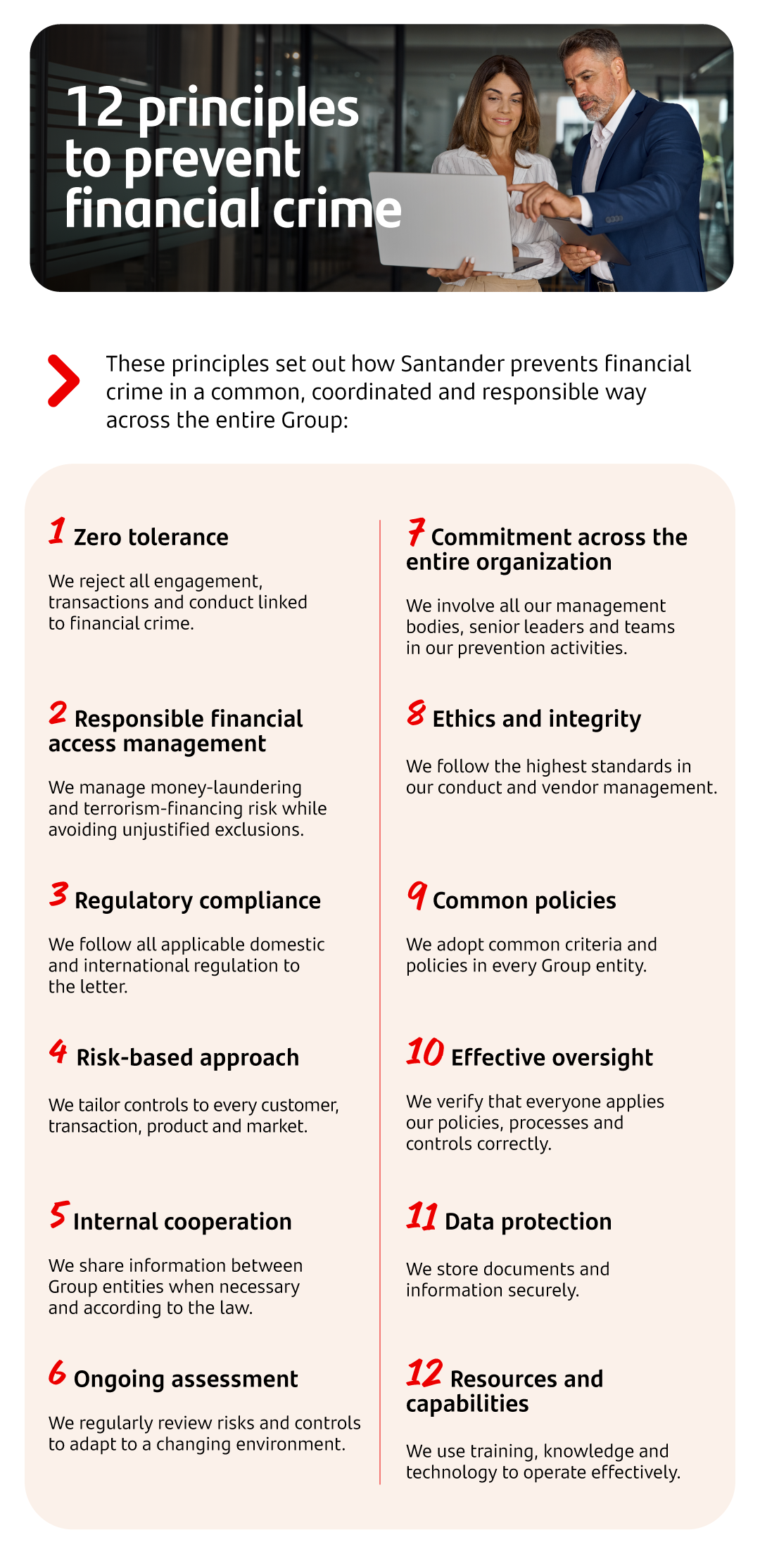
To ensure a consistent approach across all the markets in which we operate, Group entities follow the Financial Crime Compliance (FCC) Corporate Framework. This Framework establishes common principles, responsibilities, processes and governance structures for managing these risks across Santander. These principles help us manage risks consistently, strengthen our controls and maintain a shared culture of compliance.
Zero tolerance for financial crime
Our starting point is clear: zero tolerance for financial crime. This principle extends to customers, employees, suppliers, contractors, other third parties, and transactions that may be linked to illicit activities.
Integrity guides the way we act and make decisions. That is why we operate according to high ethical standards and require compliance with applicable national and international laws and regulations.
To put these principles into practice, we have common policies and standards that establish consistent minimum requirements across the Group and are adapted, where necessary, to the laws and regulations of each market.
Prevention starts with all of us
Preventing financial crime involves the entire organisation. Our model is built on the accountability of employees, senior management and governance bodies, as well as the commitment of senior leadership to fostering a strong culture of compliance.
The business areas, Financial Crime Compliance and Internal Audit perform distinct roles within our three lines of defence model, from identifying and managing risks to overseeing and independently assessing our controls.
Training and awareness are also essential. That is why we provide ongoing training tailored to employees’ roles and levels of risk.
Not all risks are the same. Neither is our response.
We apply a risk-based approach that enables us to implement proportionate and effective controls according to the risks identified.
This approach allows us to effectively manage money laundering and terrorist financing risks while facilitating access to financial services, using the information obtained through due diligence processes responsibly and avoiding discriminatory practices or unjustified financial exclusion.
We also monitor the effective implementation of our policies, processes and controls to ensure that they are operating as intended.
Cooperating to better prevent and manage risks
Cooperation among Santander entities is another important element of our model. In accordance with applicable regulations, we share relevant information for due diligence processes and the management of money laundering and terrorist financing risks, while ensuring confidentiality at all times and complying with the legal requirements of each jurisdiction.
We also actively cooperate with the relevant national and international authorities and securely protect and retain FCC-related documentation.
Financial crime does not stand still. Neither do we.
Financial crime evolves, and our response must evolve with it.
That is why we regularly assess our risks and controls, monitor their effectiveness and continuously review our model. This dynamic assessment helps us identify emerging threats, detect areas for improvement and strengthen our ability to prevent financial crime.
This is how we build a common approach across Santander: preventing, detecting and responding to financial crime with integrity, accountability, expertise, technology and effective controls, contributing to a safer and more transparent financial system.