Mexico ranks among the world’s 15 largest economies, with a population of more than 134 million and a vast territory bordered by two major oceans that connects and links the entire American continent. Within its borders, the country is made up of distinct regional economies that differ significantly from one another, yet together form a powerful economy that reflects Mexico’s social and cultural diversity.
Mexico has a promising development outlook based on several unique factors. On the one hand, it borders the world’s largest economy and has established itself as a key player in the evolving global trading landscape. On the other, it benefits from a well-diversified economy and a large population.
This potential is complemented by economic engines distributed across different geographical areas. A closer look at Mexico's different regions reveals a truly diverse country, with areas specialising in everything from manufacturing and technology to agriculture, services and tourism. Rather than relying on a single dominant industry, the country’s economy is built around a range of activities distributed across regions, each with its own distinct economic identity.
Industrial north, tourist south
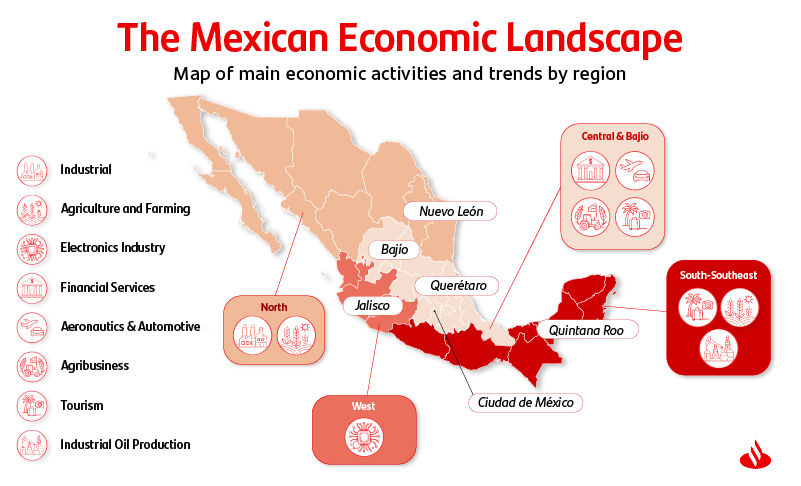
In the north, with states such as Nuevo León, we find Mexico’s industrial heartland, closely integrated with the United States market. It is an area with drive and development that coexists with large regions dedicated to agriculture and livestock farming. At the other end of the country, in the south and south-east, led by Quintana Roo, Mexico is a tourism powerhouse that also includes oil-producing areas and livestock farming, although the region still faces development challenges.
In the west, where Jalisco is the leading economic driver, another side of Mexico is emerging, characterised by a diverse economy that is increasingly focused on the electronics industry. Meanwhile, central Mexico, including Mexico City and the Bajío corridor centred on Querétaro, is home to a vibrant economy spanning financial services, specialised industries such as aerospace and automotive manufacturing, agriculture and tourism, all supported by strong development prospects.
New growth hubs
Mexico also faces challenges, such as how to balance development in those traditional regions with progress in other locations. By 2030, the country aims to establish 13 new growth hubs, bringing semiconductor manufacturing to the north-west, electric mobility to the north, additional manufacturing capacity to the centre, logistics and petrochemicals to the east, electronics and metalworking to the south, and international trade and energy to the south-east.
The goal is to create industrial hubs that give new meaning to productive activities and generate a more balanced development among the various areas of the country. This strategy is bringing new regions into the spotlight: Hermosillo, Durango, Zapotlán, Altamira, Huamantla or Chetumal, among others.
Ultimately, the challenge is not only to organise this new wave of regional industrial development, but also to provide the infrastructure, energy, financing, logistics and skilled workforce needed to support a country that is building a new platform for production and global competitiveness.