


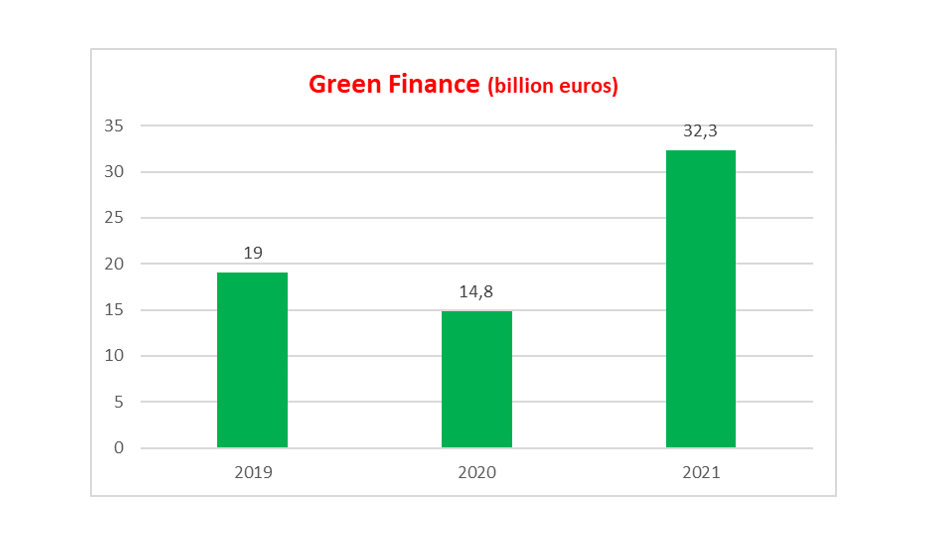
In just three years, the bank has mobilized 65.7 billion euros in green finance.
Santander will disclose its new decarbonization targets for oil and gas; mining and metals; and aviation by year end, and for mortgages, property and auto manufacturing in Q1 2024.
Madrid, 10 March 2022.
Banco Santander mobilized over 32 billion euros in 2021, doubling its green finance assets. In just three years, it has reached over half of its 120-billion-euro target by 2025. Its green finance comprises project finance, syndicated loans, green bonds, capital finance, structuring and other products that aid customers’ transition to a low-carbon economy.
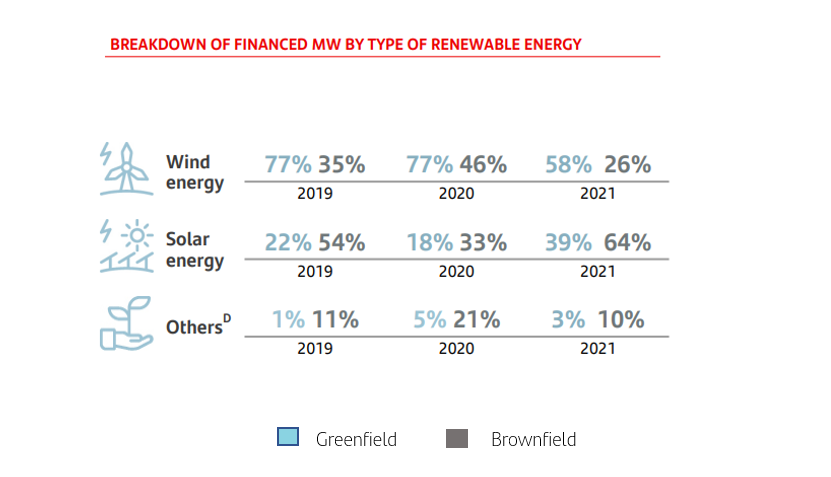
In 2021, the greenfield renewable energy projects Santander helped finance or advise had a combined installed capacity of 13,604 MW, reducing 251 million tonnes of CO2. The bank also helped expand, upgrade and maintain brownfield renewable energy infrastructure projects with a combined installed capacity of 1,776 MW.
The renewable projects Santander has financed produce enough energy to power 9.2 million homes in a year.
Santander became the top adviser on renewable energy project finance in 2021. Furthermore, its third green bond raised 1 billion euros to finance wind and solar projects in an 8-year, non-preferred senior debt issuance.
Environment and climate change
As a founder member of the Net Zero Banking Alliance (NZBA), Santander’s main climate change objective is to become net zero in CO2 emissions by 2050. Its roadmap started out last year with initial decarbonization targets for lending to thermal coal and power generation customers. They include ending financial services to customers if more than 10% of their revenue depends on coal and eliminating exposure to coal mining by 2030. Santander is already in contact with customers to review their transition plans.
Based on the Partnership for Carbon Accounting Financials (PCAF) guidelines — a global benchmark for the finance industry —, Santander has been measuring not only the greenhouse gas (GHG) emissions of customers in carbon-intensive industries (i.e. power generation, oil and gas, mining and metals, and transport) per its materiality assessment, but also its own contribution to them. Because most GHG emissions stem from businesses and value chains within those industries, they are most capable of reducing emissions to help achieve targets.
Santander will disclose new decarbonization targets for oil and gas; mining and metals (coal); and aviation (part of its transport portfolio) in September this year, and for property, car production, auto loans, cement, agriculture and some sub-industries by March 2024 to aid its customers’ transition to a greener economy.